
The way people find information is changing, and it’s changing fast. What has been the status quo for the last 20+ years is rapidly becoming just one part of a much larger conversation about how brands show up at the most critical stage of the funnel.
SEO: The Foundation
For the last 20+ years, SEO has been the primary way brands earn visibility at the bottom of the funnel, right when a customer is ready to take action. It’s the practice of optimizing your website and content so search engines like Google can find you, understand what you offer, and rank you above your competition. That means getting your keywords right, structuring your pages so crawlers can read them, building authority through backlinks, keeping your site technically healthy, and creating content that genuinely serves the questions people are asking. At Fusion, our SEO strategy has been built on these principles, using intent-driven, service-specific, and location-based content to put our clients in front of the right people at the right time. For a deeper dive into how SEO works and how to build a long-term strategy around it, check out our full guide: SEO Strategies for Long-Term Success.
But here’s where things are shifting. A traditional search engine gives you a list of links to choose from. You type in a query, you get 10 blue links, and you click through to find your answer. An answer engine, like ChatGPT, Perplexity, or Google AI Overviews, works differently. It reads across the web, synthesizes the information, and gives the user a single generated answer, often citing only a handful of sources. The user never clicks through to your site. They get the answer right there. This is the fundamental limitation of traditional SEO in today’s landscape. You can rank #1 on Google and still get zero clicks if an AI engine is answering the question for the user before they ever see your link. But it continues to be of value today and will continue to be in the future.
Enter GEO
What is GEO, or Generative Engine Optimization? GEO is how you optimize your content and website so that it’s referenced in an LLM or AI-powered answer engine. It’s optimizing for generated answers, not just ranking links. AI engines only cite 2–7 domains on average per response, unless you’re performing deep research, which is far fewer than the 10 blue links on Google. That makes competition for brands tighter than ever. The playbook for GEO isn’t solidified yet, but it’s something Fusion is actively working on for our company and our clients: how to get recommended, not just ranked. Here are some current industry best practices based on how an LLM serves recommendations, but this isn’t law by any means.
To be clear, GEO is not the same as SEO. It builds on SEO’s foundation but requires different tactics. SEO is about ranking in a list of links. GEO is about being the source an AI trusts enough to cite. You’ll also hear the term AEO, or Answer Engine Optimization, which is largely the same concept as GEO since the industry hasn’t settled on one name yet. Think of them as siblings, not strangers. The following are today’s current industry best practices.
Structure content for direct answers. Because the models are being used as answer engines, structuring your content to answer questions within the first 40–60 words helps an AI engine find a clear, concise response to surface.
Maintain high fact density. Include statistics and cite authoritative sources throughout your content. AI models favor data-rich pages because verifiable data drives higher confidence in their citations.
Question-first content structure. Structuring content in a question-and-answer format helps AI engines understand what they’re reading, making it more likely they’ll serve up your answers and recommend your brand or products.
Schema markup. Clear markup makes it easier for models to attribute snippets back to you, improving citation odds.
Keep content fresh. AI engines weigh recency in their citation decisions, especially in fast-evolving domains. Stale content loses citation authority even when it’s still technically accurate.
Understand platform differences. ChatGPT favors encyclopedic content, Perplexity rewards recency and community examples, and Google AI Overviews prioritize existing top-ranking content. A one-size-fits-all approach won’t work.
Build entity authority. AI models understand topics through entity relationships, not just keywords. Establishing a clear primary topic per page and connecting it to authoritative sources through strategic linking helps AI engines recognize your brand as a trusted resource.
Keywords still matter, but differently. In SEO, keywords were about matching exact search terms. In GEO, it’s less about exact phrases and more about topical authority and context. AI models understand intent and meaning, not just word matching. Understand what language your customers use, but focus on being the most comprehensive, trustworthy answer to their questions rather than stuffing specific phrases.
E-E-A-T still matters. Experience, Expertise, Authoritativeness, and Trustworthiness remain critical for GEO. Content with transparent author bios, reputable citations, and consistent updates outperforms shallow material in AI citations.
Fusion is actively researching and developing solutions to better position ourselves and our clients for GEO, preparing for a world where more and more traffic is answered rather than searched. According to a paper from the London School of Business and UCLA, users who adopt AI use traditional search engines 20% less than they did prior to adopting AI. Gartner has predicted that traditional search volume will drop 25% in 2026 as users shift to AI-powered answer engines. The scale is already massive. Google’s AI Overviews now reach more than 2 billion monthly users, and ChatGPT serves over 800 million users every week.
What Does This Mean for You?
You might be wondering: if we already have SEO, why do we need GEO? The short answer is that the way people find information is changing. When a potential customer asks ChatGPT or Perplexity for a recommendation, and your brand isn’t in the answer, it doesn’t matter how well you rank on Google. You were never in the conversation. SEO gets you found in search results. GEO gets you cited in AI answers.
And here’s what makes this even more compelling. According to a recent 13-month study published by Search Engine Land, traffic that comes from LLM referrals converts at roughly 18%, higher than any other channel, including paid search, SEO, and paid shopping. The volume is still small, but the quality of that traffic is unmatched. As AI adoption accelerates, the brands that only invest in SEO will increasingly be invisible at the exact moment a customer is ready to act.
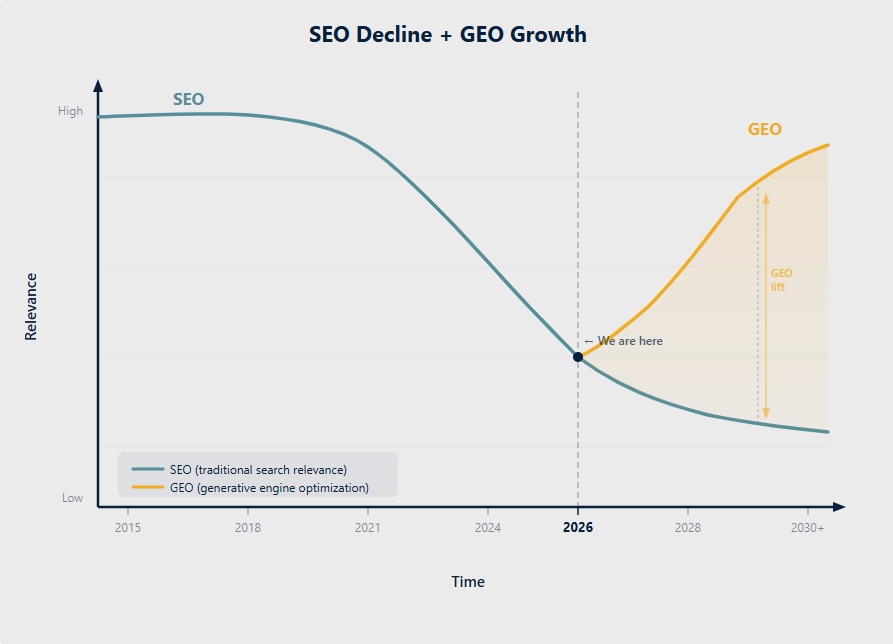
There’s been a shift from ranking to being referenced, and eventually, it will be a world where brands are selected by AI agents acting on behalf of consumers. But this is not a one-size-fits-all situation. You will still need SEO, especially for Google AI Overviews, and practicing good SEO hygiene is very similar to practicing GEO hygiene.
At Fusion, we are constantly working to stay on the leading edge of marketing practice and technology. If you want to understand where your brand stands in both search and AI visibility, let’s connect!.